A split at a window horn in Clairemont can sit through a dry summer. Then a week of marine layer, or the first hard rain off the Pacific, pushes water behind the foam. EIFS maintenance is the work of catching that joint, stain, or soft spot while it is still upkeep, before the wall has to be opened.
What regular EIFS care actually includes
EIFS is a layered cladding: foam board, a base coat with mesh, and a thin acrylic finish. People call it synthetic stucco. Dryvit is one common brand on San Diego County houses, not the only system. Synthetic stucco maintenance is not a recast of traditional three-coat stucco. The finish is thinner, the joints do more of the weather work, and water that gets in has foam to sit in.
Regular care is a close look, not a product ritual. Walk the walls after a storm and again after a Santa Ana. Check every window, door, hose bib, light box, vent, and roof-to-wall line. Look at corners, deck ledgers, and anywhere a railing or awning was lagged through the finish. Note cracks, pulled sealant, punctures, bulges, and stains that return after the sun dries the surface. Photograph what you see so the next pass has a baseline.
Cleaning belongs in that walk only when the finish is intact. Salt film on Point Loma, Ocean Beach, and Imperial Beach walls is real. Dust and UV chalk show up faster inland in El Cajon, Santee, and Escondido. A gentle rinse can lift that film. High pressure is a different job, and it is not automatic upkeep.
No verified calendar lives in our claims file. We cannot tell you to service Dryvit, or any other EIFS brand, every spring or every other year as a rule. The matched licensed pro and the system maker set the interval for that wall. If a written warranty exists, it is theirs, not ours. Ask for the maker’s care sheet for the finish on your house, and keep it with the original job papers if you still have them.
A homeowner can look and rinse. Once the work needs a building permit, or the labor and materials together hit one thousand dollars or more, California treats it as contractor work. Both conditions matter. Splitting the same job into smaller invoices does not change that. Check the person you hire on the CSLB license lookup. Stucco and EIFS work sits with a C-35 (lathing and plastering) license. Stucco Pro SD matches you with licensed independent pros. We do not hold the trade license, and we do not put hands on the wall.
How to read joints, corners, and wall openings
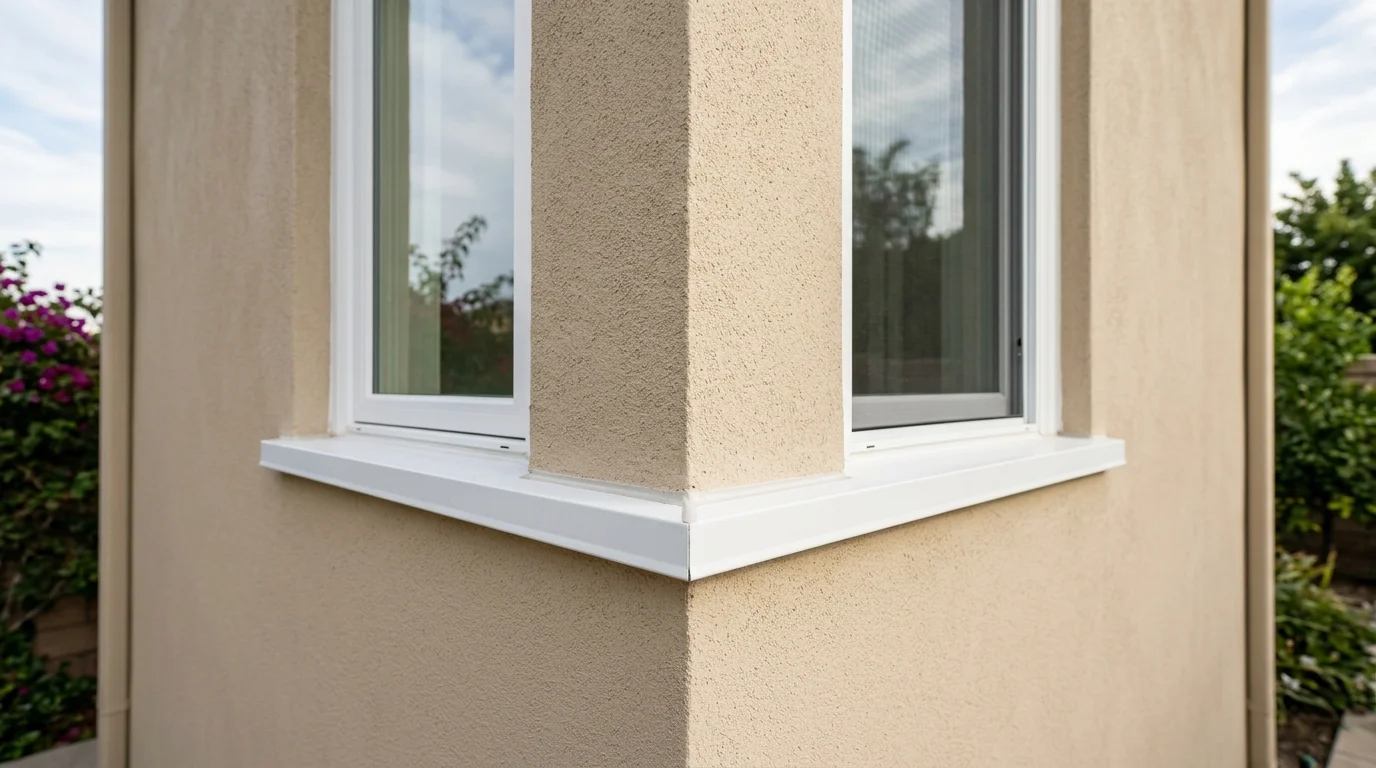
Most EIFS trouble in this county starts at a penetration, not in the middle of a blank field. Read the joints the way water would. Start at the top of the wall and work down. Roof kickouts on hillside houses in La Mesa, Mount Helix, and Escondido dump rain at a wall corner if the metal is short or missing. Window heads take wind-driven rain on the coast from Encinitas down through Coronado. Sills hold irrigation overspray in Chula Vista and National City yards.
Look at the sealant itself, not just the paint. A joint that has pulled away from the frame, split down the middle, or turned hard and shiny has stopped doing its job. Recaulking over failed material is not maintenance. It is a delay. Our guide to EIFS joints and sealant failure covers the patterns that keep coming back after a cheap bead.
Corners move. East County heat and a cool marine night in the same week will work a south and west wall harder than a shaded north wall in North Park. Hairline cracks at outside corners and at the horns of window openings are the usual first marks. A crack that is only in the finish and does not feel soft can still be a path. A crack that maps to a bulge, a hollow sound, or a stain on the drywall inside is no longer a joint note. It is a moisture note.
Wall openings include the ones people forget. Cable plates, dryer vents, security cameras, and patio-cover lag bolts punch the lamina. Coastal condos in Pacific Beach, Mission Beach, and La Jolla add deck ledgers and sliding doors on the same plane. If the seal around those points is open, washing the wall later will push water in, not keep it out.
Do not guess at weep details, coat thickness, or a legal drainage height. Those figures are not in our verified file, and a wrong number does not help you. If the bottom of the wall stays dark after the rest dries, or if soil and mulch sit against the finish, tell the matched pro. Let that person read the assembly on site.
When cleaning helps and when it hides a leak
Dryvit cleaning and other EIFS washing jobs get searched for a reason. San Diego walls get dirty in two different ways. Coastal north county and the South Bay pick up salt and a sticky film from the marine layer. Inland north county and East County pick up dust, irrigation stain, and UV fade. A dirty wall is not automatically a failing wall.
Cleaning helps when the finish is sound, the joints are closed, and you are lifting surface soil. A garden hose, a soft brush, and a cleaner the system maker accepts is the usual homeowner path. If you are not sure the product is compatible with the finish on your house, stop and ask. Hardware-store mixes made for concrete or three-coat stucco are not a free pass on EIFS.
Pressure washing is the question people actually type. High-pressure water can scar a thin acrylic finish and drive moisture into a joint that already failed. We do not have a verified psi cap in our claims file, so we will not invent one. The safe method is the one the system maker writes and the licensed pro follows on that product. If a bid leads with a hot pressure wash and no joint check, that is a wash, not Dryvit maintenance.
Cleaning hides a leak when the stain is coming from behind the finish. A gray or tan patch that lightens after a wash and returns in the same rectangle is often wet foam or a wet sheathing line, not dirt. Algae that always reappears under a window sill is pointing at the sill, not at the whole elevation. If the wall feels spongy after it “looks clean,” the wash did you a favor by removing the camouflage. That is the moment to stop rinsing and get an EIFS moisture inspection instead of another cleaning pass.
Coastal salt is worth rinsing because it sits on the finish and in the joints. Inland dust is worth rinsing because it holds moisture against the surface after a rare rain. Neither rinse repairs an open joint. If you clean first and the same corner darkens again, you did not fail at maintenance. You found the next step.
What should trigger a repair instead of more upkeep
Upkeep stops when the cladding is no longer a closed skin. Soft or hollow areas, blisters, finish that peels in sheets, rust streaks from fasteners, and interior stains below a window or at a ceiling line are repair flags. So is sealant that fails twice in the same joint after a recaulk. Keep washing and recaulking at that point and you are managing the look while water moves.
Punctures from ladders, holiday lights, and satellite mounts are small on the face and large behind it if they sit open through a wet week. Do not pack them with a tube of house caulk and call the wall maintained. Incompatible materials are a common way a small hole becomes a wider delamination. The matched pro uses components the system maker accepts for that lamina. That is also why a hardware-store patch kit is a poor stand-in for how to repair EIFS when the foam is already wet.
We cannot tell you how long EIFS should last. No verified lifespan sits in our claims file, and repeating a marketing number would be a guess. Service life depends on the original install, the joints, the roof and window details, and how long water had to sit. The system maker and the licensed contractor who inspects your wall are the people who can speak to that house.
We also cannot quote a repair price here. Cost follows how far moisture has moved, how much lamina has to come off, access, and finish match. Anyone offering a flat “starting at” number before they have seen the wall is guessing. California does cap a home-improvement down payment at one thousand dollars or 10 percent of the contract, whichever is less. On a large job that cap is one thousand dollars, not 10 percent of the whole number.
Insurance questions come up because older EIFS has a reputation. We have no verified statewide rule in our file that says a carrier must decline EIFS. Ask your own insurer what they underwrite on your address. Do not let a forum story set your next step. If the wall is wet, the next step is still a licensed look, not another coat of paint.
Wildland-urban interface rules can affect exterior walls in parts of this county. Whether your parcel sits in a mapped fire hazard zone is a mapped fact, not something a blog can assign. Check Cal Fire’s maps and your city or county building department. Inside the City of San Diego, start with Development Services. Other cities run their own counters.
How to compare a maintenance visit with a repair scope
A maintenance visit should read the wall and leave you a written list. Joints, openings, punctures, stains, and any soft spots belong on that list. If cleaning is in the scope, it should say the method and the product, not just “wash the stucco.” If sealant work is in the scope, it should name which joints and whether old material comes out first. A visit that only brightens the finish and ignores the window horns is a wash day.
A repair scope is a different document. It names the area to open, what happens to wet foam, how the mesh and base coat go back, and how the finish will be matched. Texture and color on a Carlsbad or Rancho Bernardo wall will not hide a cold patch if the repair is only a smear on top of failed lamina. If you already know the wall is past upkeep, go to EIFS repair rather than shopping for another maintenance rinse.
Compare the two scopes on the problem, not on the visit length. If the wall is soft, a maintenance bid is the wrong product. If the wall is sound and the joints are tired, a full tear-off bid is the wrong product. Ask the contractor to walk you to the spots they wrote down. Ask which system is on the house if they can tell, Dryvit or another maker, and which materials they will use against that system.
Confirm the license on the CSLB site before you sign. Confirm the down payment follows the one-thousand-dollar or 10 percent cap, whichever is less. Confirm who pulls a permit if the city or county requires one. Stucco Pro SD does not pull permits and does not perform the work. The independent licensed pro you are matched with does.
San Diego County is not one climate. A shaded wall in La Jolla holds moisture longer than a west wall in Alpine. A South Bay house near the bay sees salt the inland valleys never see. A good maintenance note names those elevations. A good repair note names how far the wet area actually runs. If the paperwork could be copied onto a house in another state with the city swapped, it is not specific enough for this wall.
When to call us
Call when joints are open, the finish feels soft, a stain returns after cleaning, or you cannot tell if the next step is a wash or an opening in the wall. That is licensed C-35 work once it leaves casual upkeep. Call us at (858) 400-4352 and we’ll connect you with a licensed local stucco contractor.