People typing “stucco repair santa fe” often get New Mexico plaster shops. This page is for Rancho Santa Fe in inland north San Diego County, where a long cream wall faces the drive and a patch that would hide on a small lot reads as a blotch from the street. The decision is not whether someone can fill a crack. It is whether the matched pro can make that fill disappear on a wall you see every time you come home.
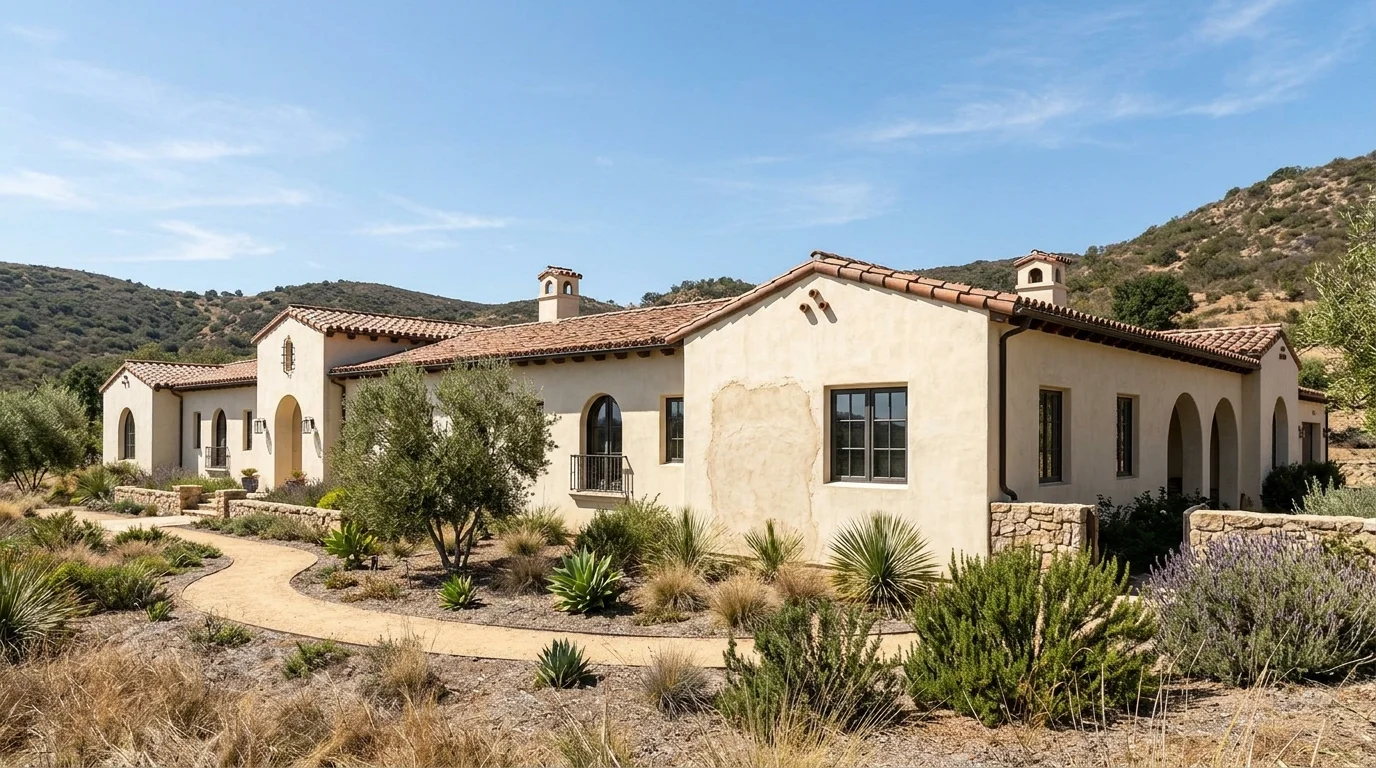
Why estate-scale walls change a repair plan
A short wall forgives a slightly cooler patch. A Rancho Santa Fe elevation does not. Inland north county sun hits south and west faces harder than a shaded coastal street in Encinitas, so color on those long planes fades unevenly. The same mix that blended last year can look like a map of the repair once late-day light rakes across it.
Scale also changes what is actually failing. Hairline cracking near a window can be a surface issue. Soft, hollow, or bulging stucco is a different job. If the finish has pulled off the lath, or water has been sitting behind the coat, a neat square of stucco patching will not hold. The licensed contractor you are matched with has to say which it is before anyone cuts the wall.
Estate lots add access that a city bungalow never has. Long setbacks off Via de la Valle, Linea del Cielo, or Del Dios Highway mean the crew may be working far from the street. Gates, decomposed granite, mature oaks, and slope all change how material gets to the wall. Height matters too. A two-story gable or a tall garden wall is not a ladder job. Staging, protection of plantings, and how the finish is reached become part of the plan, not extras tacked on later.
Repair versus replace is the first fork. Isolated cracks, a failed window return, or a small impact mark can stay a repair. Widespread crumbling, detachment from the wall, repeating water stains, or a finish that is already a patchwork of old repairs usually points toward a larger recoat on that elevation. No lifespan figure is verified for stucco on this site, so do not let anyone sell you a year count. Ask what is failing, why, and how far the sound stucco actually runs.
If the property sits in an HOA, a homeowner association, or the historic Covenant, finish rules may apply. This page could not confirm a single countywide color or texture rule for Rancho Santa Fe, so do not assume one. Have the matched pro and the association (or the County of San Diego building department for permit questions) confirm what is required on your parcel before anyone opens a wall.
Matching texture and color across a long elevation
On these houses, texture matching is the job. The crack is the easy part. The hard part is making the new mud read as the same sand, the same skip, or the same dash as the wall that has been weathering in inland heat for years.
Ask the contractor to name the finish on the wall and to show how they will match it. Sand finish, lace, dash, and smooth coats all catch light differently on a long plane. A sample board in the garage is not enough. Samples need to sit on the actual elevation, in the same sun the wall gets at noon and again in late afternoon. Inland Rancho Santa Fe light is drier and harder than a marine-layer morning in the South Bay. A match that looks close in shade will flash once the sun hits it.
Color is the other trap. Isolated patches on a faded cream wall almost always read as new. Sometimes the honest repair is a wider blend, a full-elevation color coat, or both, instead of a postage-stamp fill. That is a scope decision, not a sales upsell, and it should be written down. If the wall is peeling, find out whether the stucco itself is failing or whether an old paint film is letting go. Peeling paint over sound stucco is a different sequence than crumbling brown coat.
Traditional cement stucco is commonly built as a three-coat wall: scratch, brown, and finish. Two-coat and one-coat systems exist too, and they do not patch the same way. Coat thicknesses and cure times are not verified here, so do not accept a bid that leans on a number nobody can show you in code. Have the pro say which system is on your house, how they know, and which coats they are replacing. Our two-coat versus three-coat guide walks through the difference without inventing mill thicknesses.
EIFS (synthetic stucco) is another mismatch risk. Foam-based systems repair differently from cement stucco. If the contractor cannot tell you which one is on the wall, stop and get another set of eyes. Mixing the two on a visible estate elevation is how you get a shiny island in a dull field.
What to ask before anyone patches a visible wall
Start with the license. In California, stucco is CSLB C-35 work (lathing and plastering). Acting as a contractor without a license is a misdemeanor unless a narrow exemption applies. A handyman can only take the job when the whole contract (labor, materials, and everything else) is under $1,000, the work is casual and minor, and no building permit is required. That $1,000 threshold is the current figure, effective January 1, 2026. Both conditions have to hold. Splitting one elevation into smaller contracts to stay under the cap is not allowed. Anyone who advertises as a contractor loses the exemption at any price. On a long Rancho Santa Fe wall, the honest answer is almost always a licensed C-35, not a weekend patch.
Look the license up yourself on the CSLB license check. Use that page, not a third-party listing. Confirm the number is active and that C-35 (or another classification that actually covers lathing and plastering on your job) is on the card.
Then ask these, in this order:
What system is on the wall, and how do you know. Traditional cement, a later one-coat, or EIFS.
Where will the patch stop, and how will the texture and color be blended into the rest of the elevation.
If the stucco is peeling, is the failure in the finish, the brown coat, or water behind the wall.
Do you recommend a local repair or a recoat of the whole face, and why. What a good stucco repair looks like is the visual test: edges that do not telegraph, texture that continues through the joint, and no halo once the wall dries.
Will this work need a permit. That is a local building-department call. This page could not confirm a blanket permit rule for Rancho Santa Fe parcels. Ask the matched pro and the County of San Diego (or whichever department covers your address). Inland north county also includes mapped wildland-urban interface areas under California Building Code Chapter 7A. Never assume your lot is or is not in a fire severity zone. Check Cal Fire’s maps and the building department for the parcel.
On a home-improvement contract, the down payment cannot exceed $1,000 or 10 percent of the contract, whichever is less. On a large estate job the cap is $1,000, not 10 percent of a big number.
How access, height, and finish samples affect the bid
Stucco work in San Diego County is quoted by the job and often by the square foot. The number moves with substrate, access, height, and finish. No starting price belongs on this page. What you can compare is how each proposal treats the things that make an estate wall expensive to do well.
Access. Can a lift or scaffold sit on the drive, or does the wall sit behind a garden, a slope, or a narrow side yard. Protecting decomposed granite, irrigation, and mature planting is part of the bid, not a surprise on day two.
Height. A single-story garden wall and a two-story street elevation are different setups. If the proposal is silent on staging, it is not a complete bid.
Samples. A serious Rancho Santa Fe stucco contractor will budget time to build samples on the wall and let them dry in place. Wet stucco is darker. A match judged while the mud is still damp will disappoint you a week later. Ask where the sample will live, how long it stays, and who signs off before the rest of the elevation is opened.
Scope of the blend. A one-square-foot fill priced like a driveway crack is not the same job as blending three window bays so the face reads as one wall. If two bids are far apart, it is often because one is patching a hole and the other is matching a plane.
Written exclusions. Window flashing, roof-to-wall junctions, and irrigation spray against the base of the wall are common water sources. If those are out of scope, the patch can fail for reasons that have nothing to do with the mud. Get that in writing.
Our hiring guide for a San Diego stucco contractor is the checklist to run while you are still collecting proposals, before anyone mixes a bag.
What Rancho Santa Fe homeowners should compare across proposals
People searching for the best stucco company Rancho Santa Fe can find are really comparing three things: license, matching method, and whether the bid is a patch or a recoat in disguise.
License and classification, verified on CSLB, not on a yard sign.
A named finish and a matching method, including on-wall samples and who approves them.
A clear repair-versus-recoat recommendation for that elevation, with a reason you can walk outside and see.
Access, height, and protection of the grounds, priced as part of the work.
Permit responsibility, assigned to the licensed contractor, with the local building department named.
The deposit, at or under the legal cap.
Warranty language that belongs to the contractor who does the work. Stucco Pro SD matches you with licensed independent local pros. We do not hold the trade license, we do not pull the permit, and we do not warrant the mud. Only the matched pro does.
If two proposals still look identical, walk the wall at 4 p.m. and ask each contractor to point at the blend line. The one who can show you where the new work will disappear is the one who understands estate-scale stucco repair in Rancho Santa Fe. The one who talks only about filling the crack is bidding a different house.
Stay on residential work for this property. Commercial recoat language does not help a long house wall that has to match itself in raking sun.
When to call us
Call when a visible Rancho Santa Fe elevation has cracking, peeling, hollow spots, or a patch that already shows, and you need a licensed C-35 pro who will match texture instead of filling a hole. Call us at (858) 400-4352 and we’ll connect you with a licensed local stucco contractor.