Why prep is where the paint job actually happens
An exterior repaint of a San Diego stucco home is more prep work than painting. A professional crew applying quality paint to poorly prepared stucco will have a failed paint job well before its time. The same crew doing thorough prep before a standard paint application gives the paint a real chance to last. How long it lasts depends on the product, the sun, and whether the wall stays dry.
This sounds obvious, but the temptation to shortcut prep is real on both sides: homeowners want the project done faster, and budget-focused crews can make the math work by cutting time on the steps that don’t feel like painting. Understanding what proper prep involves lets you ask the right questions before the job starts.
Step 1: inspect and address the stucco before any cleaning begins
Before a pressure washer touches the wall, the stucco needs a thorough visual inspection for cracks, delamination, and any areas of moisture damage.
Cracks in the stucco need to be filled before painting. Paint alone does not bridge cracks; it spans them temporarily and then opens with the crack when the underlying stucco moves with temperature changes. A crack that gets painted over without repair will telegraph through the paint coat when the wall moves.
Any cracks wider than a hairline should be filled with an appropriate flexible exterior caulk or patching compound, allowed to cure, and sanded flush before cleaning begins. Hairline cracks can be treated with a high-build elastomeric primer that bridges small surface cracks as part of the coating system, but this is not a substitute for filling larger cracks.
Delaminated or hollow-sounding areas of stucco need to be repaired or removed before painting. Painting over delaminated stucco creates a paint surface that has no structural backing and will fail when the delaminated section eventually drops. Tap across the wall with a mallet before painting to identify hollow sections.
For detailed guidance on evaluating cracks before repairs begin, see the hairline vs. structural cracks guide.
Step 2: cleaning the stucco surface
Stucco is a porous material that accumulates dust, dirt, biological growth, and in coastal San Diego, salt deposits over the years since the last paint job. Paint applied over a dirty or contaminated surface will not bond properly.
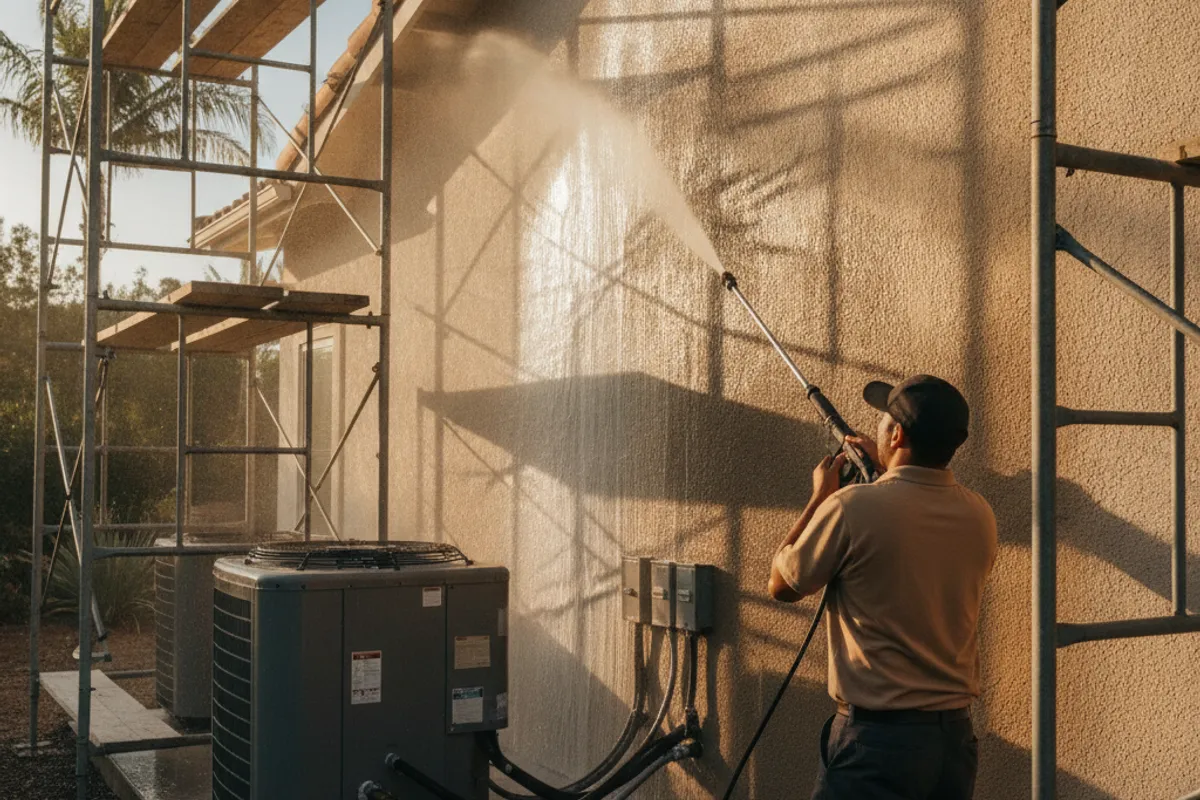
Pressure washing at a setting the crew confirms for that finish, lower than they would use on concrete, removes loose material, surface dirt, and most biological growth. There is no one safe PSI for every San Diego texture. On north-facing walls in Oceanside, La Mesa, and Pacific Beach that accumulate mildew due to lower sun exposure and higher humidity, a cleaning solution containing a mildewcide is applied before washing.
Efflorescence, the white mineral salt deposits that appear on stucco surfaces, requires a dilute acid wash or a dedicated efflorescence remover. Pressure washing alone does not remove efflorescence cleanly; it needs chemical treatment. Skipping this step leaves a chalky, weakly bonded surface that paint will not adhere to well.
After washing, the stucco needs to dry completely before primer or paint goes on. In San Diego’s coastal zone, particularly in June through August when the marine layer is consistent, drying time after washing is a real scheduling factor. The paint crew writes the wait from the weather and the wall, not a one-size wait.
Step 3: masking and protecting adjacent surfaces
Stucco repaints involve masking windows, doors, trim, hardscape, and landscaping adjacent to the walls being painted. This step is often rushed on budget jobs, and the result is overspray on windows, paint on pavers, and poor paint lines at the trim.
For San Diego homes where HOA architectural guidelines specify crisp paint lines between body color and trim color, masking is not negotiable. The time spent on careful masking is recovered in not having to clean up overspray.
Step 4: primer selection and application
Stucco primer is not optional. Stucco is alkaline, particularly new or recently patched stucco, and alkalinity can cause paint failure through saponification (a chemical reaction between the alkali and paint binders that breaks down the paint film). A masonry primer seals the surface, controls alkali, and creates a uniform surface profile for the topcoat to bond to.
For San Diego applications where the stucco may have moisture cycling, particularly in coastal neighborhoods from Chula Vista through Carlsbad, a penetrating masonry primer that bonds deeply into the porous stucco surface provides better adhesion than a film-forming primer.
If any stucco patches were made, the patches need to cure fully before priming. Fresh stucco has high alkalinity and high moisture content; applying primer too soon can cause adhesion problems at the patch locations. The product label and the crew set the cure wait. This page does not.
Step 5: selecting the right paint for San Diego stucco
Not all exterior paint is right for stucco. The right paint for a San Diego stucco repaint is:
Elastomeric: Elastomeric coatings are significantly thicker and more flexible than standard exterior latex paint. They bridge hairline cracks and accommodate the thermal movement of stucco without cracking. For coastal San Diego properties where salt air and UV both attack the paint film, elastomeric paint consistently outperforms standard exterior latex on a cost-per-year-of-service calculation.
Vapor-permeable: Stucco needs to breathe. A vapor-barrier paint traps moisture in the stucco system, which can lead to delamination and blistering. Quality masonry paints designed for stucco are vapor-permeable.
Appropriate sheen for stucco texture: Flat or low-luster sheens are standard for textured stucco surfaces because higher sheens emphasize texture variation. On a smooth trowel or Santa Barbara finish, a slightly higher sheen may be appropriate for the aesthetic look, but this is the exception.
How the San Diego coastal environment affects timing
San Diego’s marine layer, most consistent from late May through August, creates morning humidity that can delay exterior painting. Paint applied when the surface is damp or when relative humidity is too high for the product will not cure correctly.
Professional exterior painters in coastal San Diego communities work with this by painting in the afternoon hours when the marine layer has typically burned off. This is less of a constraint in inland communities in the East County and North County, where the marine layer is less consistent.
Fall, particularly September through November when humidity is lower and the Santa Ana wind season begins, is one of the better windows for exterior stucco repaint in coastal San Diego.
For information on evaluating your stucco condition before committing to a repaint, see the patch vs. re-coat guide.
Call (858) 400-4352 to connect with insured local stucco and painting crews across San Diego County. Verify any contractor’s C-35 license for stucco work or C-33 license for painting at cslb.ca.gov before work starts.