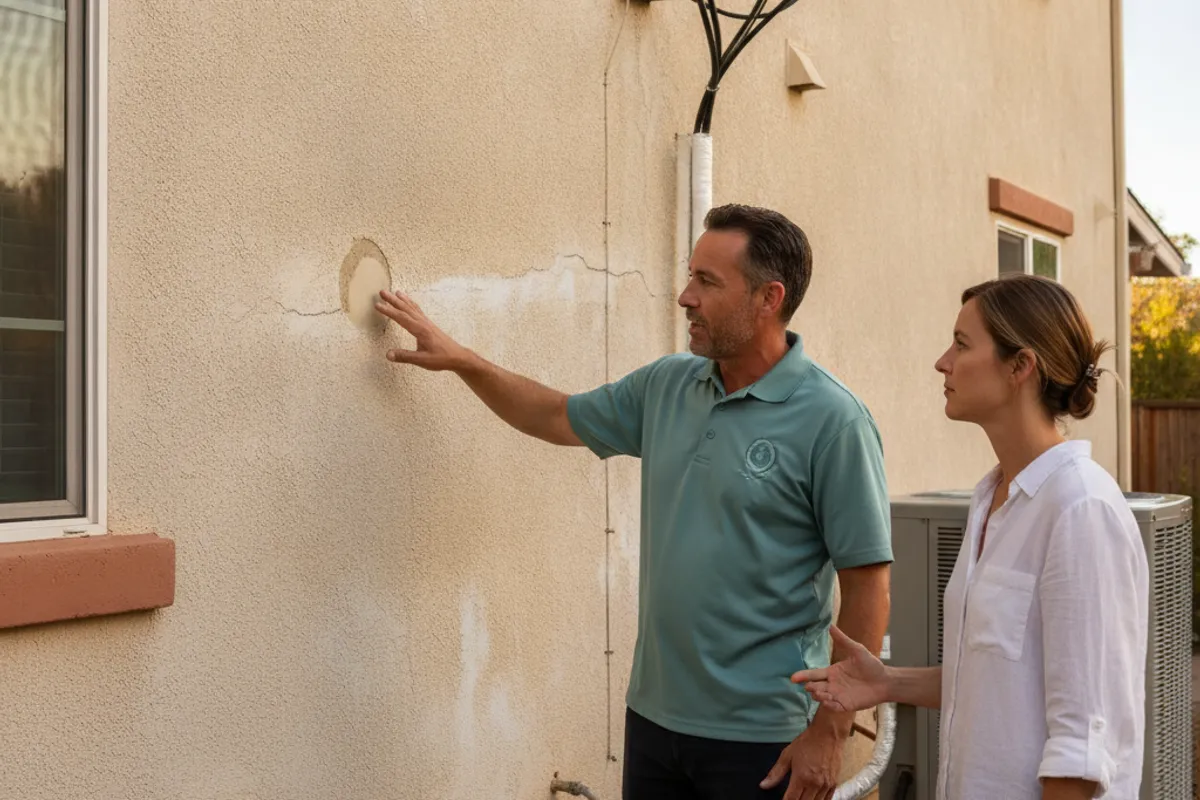
The question homeowners face most often
You have some damage on your stucco. Maybe it’s a cracked section near a window in Clairemont. Maybe it’s a hollow-sounding area on the south wall of a Lemon Grove home that’s been there for years. Maybe you’re getting ready to sell a Mission Hills bungalow and the inspector flagged three areas.
The question is the same in each case: fix the specific spots or do the whole wall? Getting that decision right saves money. Getting it wrong means either spending more than necessary or creating a cosmetic and structural problem that costs more later.
The case for patching
Patching makes sense when the damage is isolated, the surrounding stucco is sound, and the moisture cause (if there is one) can be addressed without opening a large section of wall.
Isolated impact damage, a single crack at a window corner that opened recently, or a small area where water got behind the stucco at a failed caulk joint are all legitimate patch candidates. The surrounding stucco is not compromised. The patch fixes the problem without requiring wholesale disruption.
Patching is also the right call when the damage is at one discrete location and the rest of the exterior is in good enough condition that you’re not facing a full re-coat conversation in the near term. Doing a patch today to keep an otherwise sound wall going is a reasonable strategy on a well-maintained home.
Patches on sound, unpainted stucco can match reasonably well when done by an experienced crew that knows how to match the texture and tint the patch material. On painted stucco, blending a patch into the surrounding painted surface is often easier because the paint coat over both surfaces creates visual continuity. See the stucco texture matching guide for what this process looks like in practice.
The case for re-coating the full wall
A full color coat over the existing stucco is the right call when the damage is distributed rather than isolated. If you are looking at multiple areas of cracking across the same wall, widespread pattern cracking in the finish coat, or a stucco surface that has accumulated uneven layers of patch repairs over many years, a re-coat addresses all of it at once and gives you a fresh, uniform surface.
A re-coat is also the right answer when the existing stucco shows cumulative age: fading, chalking, multiple previously patched cracks, or a texture that has worn smooth in high-traffic areas. At that point you’re maintaining an aging surface that will keep needing attention, versus resetting it with a new finish coat.
On coastal properties in communities like La Jolla, Point Loma, Pacific Beach, and Oceanside, a periodic re-coat is a common maintenance cycle for well-maintained homes, because the marine environment accelerates the wear on finish coats more than in inland locations.
What makes patching fail
Patching fails in two scenarios. The first is when the surrounding stucco looks fine but is actually delaminating. You patch the visible damage, and more areas start failing because the underlying stucco was not as sound as it appeared. This is why a thorough sounding of the surrounding area, tapping with a hammer or mallet to listen for hollow areas, is part of a proper patch evaluation before quoting.
The second is poor texture and color matching. A patch that is clearly visible as a patch, either because the texture doesn’t match or because the color cured differently, looks worse than the original damage in some cases. On homes with a distinctive texture in El Cajon or Santee where the finish was originally applied by a specific crew years ago, matching that texture exactly is a craft skill. Not every crew has it.
What makes a full re-coat the wrong call
A full color coat is the wrong answer when the existing stucco has delamination or moisture damage that a surface coat will not fix. Applying a new finish coat over stucco that is failing behind the surface does not fix the underlying problem; it buries it.
Before any re-coat is applied, the stucco should be sounded for hollow areas and any delaminated sections should be opened, repaired properly, and allowed to cure before the finish coat goes over the top. A responsible contractor does this as part of surface preparation.
A practical decision framework
To make the right call for your specific situation:
Count the damage locations. Isolated problems: patch. Damage spread across the same wall face: ask the crew whether a re-coat is the cleaner answer.
Assess the surrounding stucco. Sound it out. If large areas are hollow or suspect even where there are no visible cracks, a patch-only approach will likely lead to additional repairs.
Consider the age of the surface. Isolated damage on otherwise sound stucco: patch. Widespread wear across a wall: evaluate whether a re-coat makes more sense than continuing to patch.
Ask about color coat availability. If the existing home color is a non-standard HOA-required mix that the original contractor specified, confirming that the same or a matching formulation is available is part of the re-coat decision. This matters most in master-planned communities in Rancho Bernardo, Otay Ranch, or Carlsbad where community architectural standards are enforced.
Pricing context for San Diego
Spot patching is priced per location, and the number moves with the size of the repair, whether substrate work is needed underneath, and how complex the texture match is.
A full re-coat of a wall face or the whole exterior is priced per square foot of wall area as a color coat application, so it scales directly with how much wall you have.
The break-even point varies by how many patches you are accumulating. Repeated patch repairs on the same wall start to compete with a whole-wall re-coat. If those patches address isolated issues and last, they win. If you are back with another patch soon, the re-coat calculation changes.
Call (858) 400-4352 to connect with insured local stucco crews in San Diego County who can evaluate your specific situation and give you an honest read on which approach makes sense. Always verify a contractor’s C-35 license at cslb.ca.gov before any work begins.