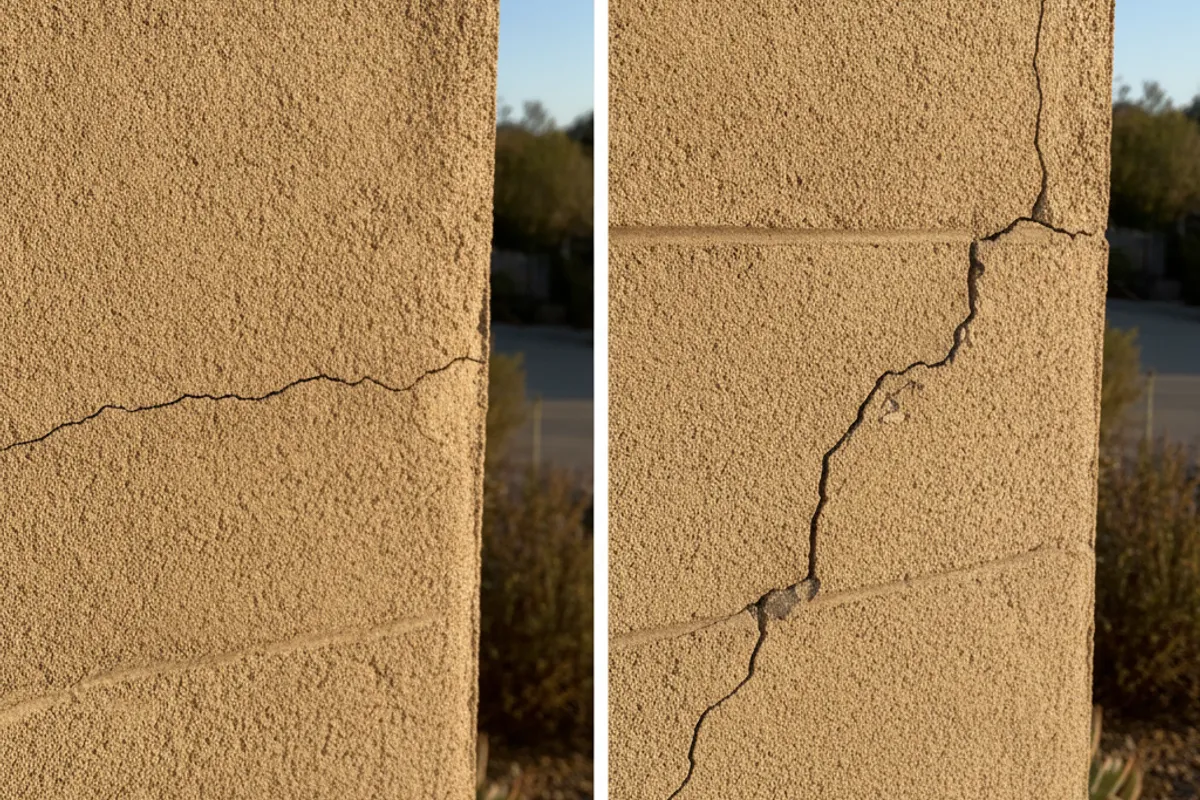
Not every crack is the same problem
San Diego stucco homes develop cracks. It’s part of the life cycle of a rigid cementitious exterior in a climate with thermal cycling, seismic activity, and in coastal areas, constant moisture. The question is not whether cracks will appear but what kind they are, because the difference between a hairline cosmetic crack and a structural crack is the difference between a maintenance item and a repair that warrants further investigation.
Misreading a structural crack as cosmetic is a mistake. So is panicking over a surface crack that every similar home in the neighborhood has. This guide helps you tell the difference.
What makes a hairline crack
A hairline crack is a surface fracture in the finish coat of the stucco that is thin enough that you can barely see it from standing distance but becomes visible on close inspection. The defining characteristics:
Width less than 1/16 inch. If a credit card edge fits into the crack, it is probably wider than a hairline. Hairlines are thin enough that you need good light to see them clearly at close range.
No offset between the two sides. The surface on both sides of the crack is at the same plane. Neither side has raised or sunk relative to the other.
Finish coat only. Scratch at the edge of the crack with a key or a dull blade. If the material around it is solid and the crack does not deepen beyond the surface layer, it has not penetrated to the brown coat below.
No associated displacement of the surrounding wall. No diagonal cracking pattern radiating from corners, no cracking in an adjacent window or door frame, no visible bowing of the wall.
Hairline cracks in the finish coat are common on older stucco. They form as the Portland cement binder in the finish coat microcontacts from thermal cycling. They are particularly common on south and west-facing walls in inland San Diego communities like El Cajon, La Mesa, Santee, and Escondido, where summer afternoons run much hotter than the coast and the day-to-night swing is wide.
What makes a structural crack
A structural crack reflects movement of the structure beneath the stucco, not just shrinkage of the stucco finish coat itself. The key distinguishing characteristics:
Width greater than 1/4 inch. Not all structural cracks are wide, but cracks significantly wider than a hairline are more likely to indicate movement rather than surface shrinkage.
Offset between the two sides. One side of the crack is at a different plane than the other, meaning the material on either side has moved in different directions. This is the most reliable single indicator of structural movement.
Penetrates through multiple coats. A crack that goes through the finish coat, the brown coat, and possibly the scratch coat has propagated through the full stucco system, which requires more force than finish coat shrinkage.
Pattern that follows structural boundaries. Diagonal cracks from window and door corners that return to a foundation line or corner, step cracks that follow masonry mortar joints, or cracks that track along the foundation-to-wall junction all follow structural boundaries and indicate structural movement.
Recent appearance or active widening. A crack that opened in the last few months, particularly if it opened after a local seismic event or after significant rainfall that could have affected soil moisture, should be treated as structural until proven otherwise.
Associated symptoms elsewhere. Doors or windows in the home that have started sticking, interior drywall cracks that appeared at the same time as the exterior stucco crack, or cracks in the concrete flatwork adjacent to the home’s foundation all corroborate structural movement.
San Diego-specific context
San Diego sits in a seismically active region. Minor tremors are common, and while most do not cause structural damage to well-built homes, they can accelerate cracking in stucco systems that were already under stress. A crack that appears shortly after a felt seismic event deserves more scrutiny than a crack that developed gradually over years.
The soil in many San Diego communities also creates specific foundation movement patterns. Expansive soils, which expand when wet and contract when dry, are common in the East County, particularly around El Cajon, Lakeside, and Santee. Homes built on expansive soils experience more foundation movement over time, and stucco on these homes may show more pattern cracking along structural boundaries than comparable homes on sandy or rocky substrates in coastal communities.
Hillside lots in La Mesa, Spring Valley, and Tierrasanta are subject to slope movement that creates differential settlement, which shows up as diagonal or stair-step cracking patterns in the stucco.
The grey zone: cracks that need a closer look
Some cracks fall between clearly cosmetic and clearly structural and need professional evaluation:
Cracks wider than 1/8 inch but showing no offset. Not necessarily structural, but wider than a surface-only crack explains.
Corner cracks at windows and doors that have been patched before and re-opened. Recurring cracks indicate ongoing movement that cosmetic patching will not solve permanently.
Horizontal cracks running across the wall at consistent intervals. These may correspond to lath lines (see the stucco crack types guide for more on lath-related cracking) rather than structural movement, but they need proper evaluation to determine which.
Long diagonal cracks on gable ends, particularly on two-story homes in Rancho Bernardo or Mira Mesa, can reflect racking movement in the upper story framing rather than foundation issues.
What to do with each type
Hairline cracks: Monitor annually. Fill with a flexible, paintable exterior sealant before the next rainy season. No urgency beyond preventing moisture intrusion from widening them over time.
Suspected structural cracks: Do not patch immediately. Monitor the crack width by making two marks across the crack and measuring the distance between them, then checking it again after more than one weather cycle. If it is stable, it may be historical rather than active. If it is widening, get a structural evaluation before any stucco repair.
Uncertain cracks: A stucco contractor can evaluate the crack and give you a reasonable read on whether it looks structural. If the answer involves any of the structural indicators described above, a structural engineer’s opinion before patching is money well spent.
Cosmetic repair of hairline cracks
For cracks that are clearly cosmetic, the right repair depends on whether the stucco is painted or in a color coat finish. On painted stucco, a flexible elastomeric caulk filled into the crack and painted over is clean and effective. On a color coat finish, the crack can be filled with a matching stucco patching compound and the area repainted or re-coated to blend.
For anything requiring texture matching to the surrounding surface, see the stucco texture matching guide.
Call (858) 400-4352 to connect with insured local stucco crews serving San Diego County who can evaluate your cracks and recommend the right repair path. Verify any contractor’s C-35 license at cslb.ca.gov before work starts.