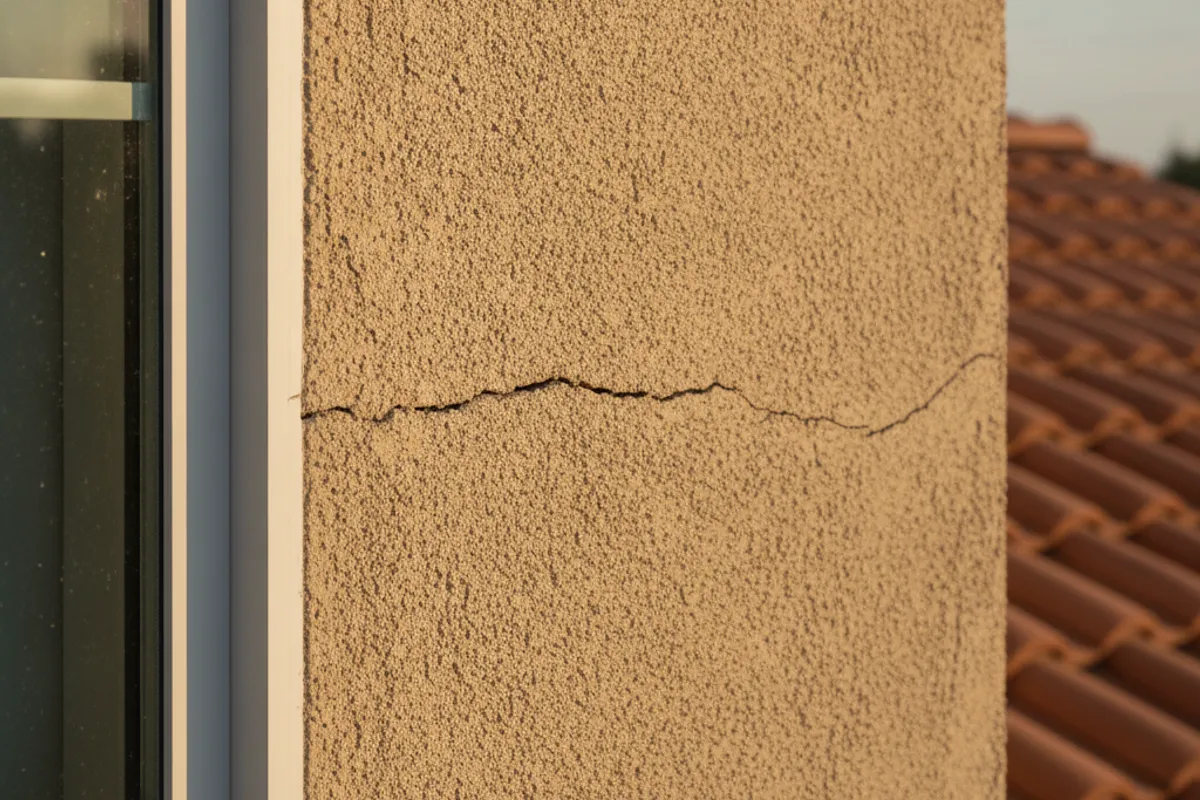
Why San Diego stucco cracks
Stucco is a rigid cementitious material applied over a flexible structure. Wood framing expands in heat and contracts in cold. Soil under the foundation shifts over time. Seismic activity, even the minor tremors common in San Diego County, creates movement that a rigid finish coat cannot fully absorb. Cracks are the result.
The question is never “why is my stucco cracking” but rather “what kind of crack is this and what does it mean for my home.” Some cracks are cosmetic. Some indicate water infiltration in progress. Some are early signs of structural movement. Each reads differently.
Hairline cracks: surface-only, usually cosmetic
Hairline cracks are thin surface fractures, typically less than 1/16 of an inch wide, that follow no particular pattern and appear in the finish coat only. They are extremely common on older San Diego stucco homes, particularly after hot, dry summers that accelerate thermal cycling.
These cracks form as the finish coat shrinks and expands over years of use. They rarely penetrate to the brown coat or scratch coat beneath. Moisture can get into them, but on a well-applied three-coat system the underlying layers provide a secondary barrier.
Hairline cracks do not require emergency repair. They should be addressed before they widen, typically during a repaint cycle, with a flexible elastomeric sealant or a resurfacing coat. Leaving them indefinitely in a coastal environment like Ocean Beach or Cardiff is a worse idea than leaving them in a drier inland location like El Cajon or Ramona, because marine moisture has more opportunity to penetrate.
For a deeper explanation of how hairline cracks differ from structural ones, see the hairline vs. structural cracks guide.
Pattern cracking: normal shrinkage, early warning sign
Pattern cracking, sometimes called map cracking or alligator cracking, appears as a network of interconnected cracks forming irregular polygons across the stucco surface. It looks like dried mud.
This pattern typically forms during the curing process of the stucco itself, when the material shrinks unevenly. It can also develop later due to long-term sun exposure on south and west-facing walls in inland areas like Santee, Lakeside, and Escondido, where temperatures hit 95-105°F in summer.
Pattern cracking that is present in the finish coat only is a cosmetic issue. Pattern cracking that has reached the brown coat means the system is aging toward a point where a full re-coat or re-stucco will eventually be necessary.
Step cracks: follow the mortar joints in CMU or brick
If your home has a concrete masonry unit (CMU) or brick veneer underneath the stucco, step cracks are cracks that follow the mortar joint pattern diagonally. They look like stair steps tracking up or across the wall.
Step cracks are caused by differential settling in the foundation or in the masonry itself. They are more common in older San Diego homes from the 1940s to 1960s in neighborhoods like Sherman Heights, North Park, and City Heights where masonry construction was common.
A step crack does not automatically mean structural failure, but it does mean foundation or masonry movement occurred at some point. The right approach is to assess whether the movement is ongoing (actively widening cracks) or historical (stable cracks that stopped when settling stabilized). An ongoing step crack warrants a structural evaluation before the stucco is patched, because patching over active movement will only result in the patch re-cracking.
Horizontal cracks along lath lines
Horizontal cracks that run in straight or nearly-straight lines across a stucco wall, often appearing in rows at regular intervals, typically correspond to the horizontal lines of the metal lath underneath.
These cracks form when the lath itself is corroding and expanding. Metal lath has to be galvanized to resist corrosion, but on older homes or homes where water has gotten behind the stucco, the lath can rust. Rust causes expansion, which pushes cracks through the stucco above it.
Horizontal cracks along lath lines are a more serious finding than surface hairline cracks. They indicate moisture behind the stucco and potential lath failure. Coastal homes in Carlsbad, Del Mar, and La Jolla are more susceptible because of salt air and humidity. Repair involves opening the stucco, replacing the corroded lath, addressing the moisture source, and re-stuccoing the affected area.
Cracks at window and door corners
Diagonal cracks extending from the corners of windows and doors are among the most common crack types in San Diego stucco homes. They radiate outward from the corners at roughly 45-degree angles.
These form because window and door openings are stress concentration points in the wall. Thermal expansion, settling, and seismic movement all focus stress at corners. They are particularly common on homes where the window and door headers were not properly reinforced, or where the control joints in the stucco were not placed correctly to manage movement near openings.
Corner cracks at windows and doors are worth monitoring. A crack that appears and stabilizes is a different situation than a crack that appears, gets patched, and re-opens within a year. Re-opening cracks indicate ongoing movement, which points to either the window framing or the foundation below that corner of the structure.
Wide cracks (1/4 inch or more): investigate before patching
Any crack wider than about 1/4 inch should be investigated before it is patched. Wide cracks indicate significant movement, and filling them with patching compound without understanding the cause is a temporary fix at best.
Width alone does not tell you everything. A 1/4-inch crack in a stable wall that has not moved in 20 years is different from a 1/4-inch crack that opened up recently. Ask the previous owner or look at older photographs to understand whether the crack is new or historical.
Wide cracks in the stucco at the foundation line, or cracks that run vertically from the foundation line upward, are a specific concern and warrant a structural assessment before any cosmetic repair.
How San Diego’s climate creates specific crack patterns
San Diego is not a single climate. The coastal communities from Chula Vista north through Oceanside experience high humidity, salt air, and the marine layer, which keeps temperatures relatively stable but introduces constant moisture. The thermal cycling that drives shrinkage cracking is less intense on the coast, but moisture-related cracking and lath corrosion are more prevalent.
Inland communities in the East County and North County interior experience 40-50 degree daily temperature swings in summer. Stucco expands and contracts with each cycle. Finish coat cracking and pattern cracking develop faster in these locations due to the greater thermal stress.
Understanding where your home sits in this spectrum helps you interpret what you’re seeing and how urgently it needs attention.
The repair decision
Most San Diego stucco homes have some cracks. The decision is which ones to address now and which to monitor. As a general rule:
Hairline and light pattern cracking: monitor, address during the next repaint. Window/door corner cracks: fill with flexible sealant now, monitor for recurrence. Horizontal cracks along lath lines: investigate moisture source, likely requires opening the wall. Step cracks: assess whether active or stable before patching. Wide cracks or foundation-level cracks: get a structural evaluation before any repair.
Call (858) 400-4352 to connect with insured local stucco crews in San Diego County who can assess and repair stucco cracks. Verify any contractor’s C-35 license at cslb.ca.gov before work starts.