After a run of hot, dry days, a hairline on the south wall is easier to see than it was in spring. In Borrego Springs that’s the usual story. The desert sun works the finish until it opens, then the crack sits in full light and keeps moving.
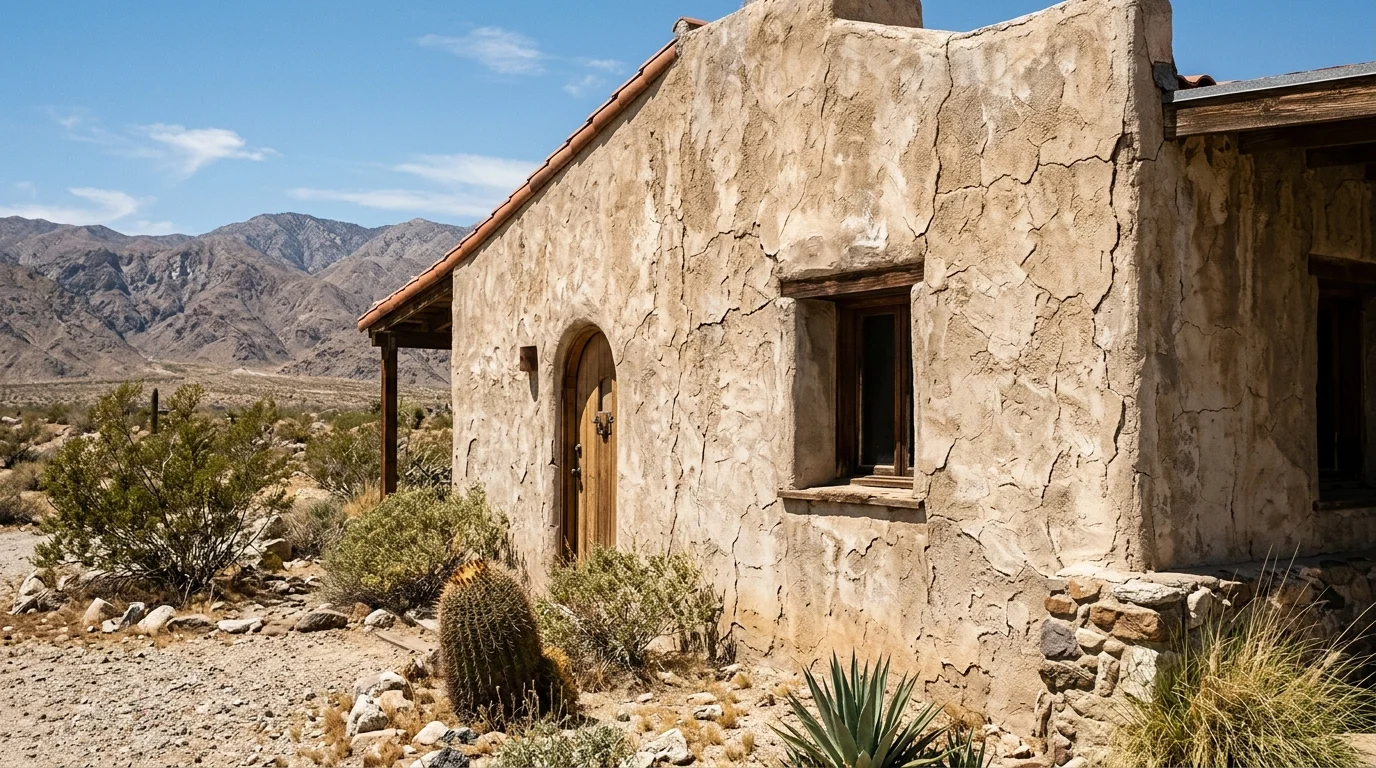
How desert heat and sun show up on a stucco wall
The sun in the Borrego Valley is the load on the wall, not scenery. Cement plaster and the framing or block behind it expand as the face heats, then they contract after dark. You don’t need a thermometer to see the result. Fine lines show first on the hottest elevations, usually south and west.
Color fades faster here too. A wall that still looks even from Palm Canyon Drive can chalk under your hand. UV wears the finish while the base coats keep moving. Once the film is tired, hairline cracks collect dust from the valley floor. The line reads darker, then it reads wider.
Wind-blown grit scours the same faces. After a windy stretch the texture looks a little flatter on the windward side. That’s wear, not a new finish. If someone color-coats over that wear without checking the cracks, the new film follows the old lines.
Moisture still matters. It just arrives on a different schedule than it does near the coast. Drip lines, overspray, and a hose at the foundation keep a strip of wall wet while the rest of the house is dry. That wet-dry band is a common crack line on desert lots. So is the strip under a window where irrigation or condensate hits the same spot every afternoon.
Walk the house after a string of hot days, not only after rain. Look at the wall that faces open desert. Look at the wall that takes afternoon sun. Photograph the same crack from the same spot a week later. If it’s lengthened or opened, you’re past waiting it out. You’re in stucco crack repair territory. The next step is a licensed look at the cause, not a tube of caulk from the hardware aisle.
Why a Borrego Springs crack is not a coastal crack
A crack in Encinitas often traces to salt air, fog, and water at the window. A crack in Borrego Springs traces to heat, UV, and a dry wall that still gets wet in one stripe. Change the city name and the diagnosis falls apart.
Coastal stucco stays damp longer. Finish coats hold moisture. Fasteners and lath see more corrosion. The repair talk starts with leaks and drainage. In the Borrego Valley the air is dry most of the year. Water that hits the wall evaporates fast, then the same spot gets hit again. That cycle is hard on joints and on the bond between coats.
Movement is the other split. Desert walls swing from afternoon heat to night cool. Framing, stucco, window frames, and roof edges don’t move as one piece. Corners and openings take the stress. A Borrego Springs crack often starts at a window corner or an outside corner, then follows the sun. That’s a desert pattern, not a coastal one.
Don’t call a diagonal line structural from the sidewalk. Appearance isn’t a diagnosis. Some lines are finish-only. Some follow lath. Some follow framing. A licensed C-35 plastering contractor is the person who can tell those apart on site. Our guide to hairline versus other stucco cracks explains why a photo isn’t enough.
Borrego Springs isn’t a city with its own building counter. It’s a census-designated place in unincorporated San Diego County. A Christmas Circle mailing address isn’t a permit boundary. For a house here, ask San Diego County Planning & Development Services whether the work needs a permit. Don’t assume a City of San Diego rule applies. If the lot sits in a mapped fire hazard area, California Building Code Chapter 7A can affect exterior-wall work. Check Cal Fire’s maps and the county building department for your parcel. Don’t take a blog’s word for your lot.
Commercial stucco in Borrego Springs lives in the same climate. A storefront on Christmas Circle, a motel wing, or a building at Rams Hill still has a west wall that bakes until evening.
What to inspect at windows, roof edges, and corners
Start at the openings. Window corners concentrate movement. Look for cracks that kick out from the upper corners, failed sealant at the frame, and staining under the sill. If the stucco around a window is soft, hollow, or dark after irrigation, stop treating it as a paint job. Window leaks and stucco cracks often travel together.
Roof edges come next. Desert roofs dump heat into the wall below. Check where the roof, fascia, and stucco meet. Look for cracks that follow the eave, open joints at a chimney, and any place a scupper or downspout soaks the same patch of wall. After a hard rain, those spots stay wet longer than the field of the wall. Highway 78 and the Montezuma Grade on S22 are how a lot of owners reach town, and how long a vacant seasonal house can sit between visits. If you only see the place in cooler months, walk the roof line on the first hot-season trip back.
Corners crack because two planes meet and the bead takes the pull. Walk every outside corner in raking light. Morning on the east side. Late day on the west. Hairlines that only show in that light still count. If a corner feels hollow or the stucco has pulled off the bead, a surface fill won’t last.
Check the band a few inches above grade, where irrigation hits. Check hose bibs and the splash zone. Check where an addition meets the original house. Check control joints if the wall has them. Tap lightly. A hollow sound or stucco that moves under light pressure is a different problem than a hairline in the color.
A bulge isn’t a hairline. Don’t patch over it. Flex Seal and similar consumer coatings aren’t a stucco repair. They can hide the crack, hold dirt, and make the next inspection harder. If the wall is bulging, the licensed pro needs to see the assembly, not a rubber skin.
For a map of how different lines behave, read stucco crack types in San Diego. Then have someone on the lot. A guess from a coastal photo will miss the heat pattern on a Borrego wall.
When a color coat will not stop the cracking
A color finish coat can even out fade and restore the look after a real repair. It can’t lock a live crack. If the base is still moving, the new color will split on the same line. You’ll have a fresher wall for a short stretch, then the map comes back through fresh pigment.
That’s the desert trap. UV has already chalked the old finish. The wall looks tired, so the first instinct is to recolor. Recoloring a wall that’s cracking from heat and movement is a finish on top of a problem. Ask the licensed pro to separate the repair from the color. Open, clean, and repair first. Color comes after the wall is stable enough to take it.
Texture matching matters because desert light is harsh and comes in from the side. A slick patch on a sand finish reads from the street by noon. A color-only pass over mixed patches will telegraph every repair. If the faded field is far from the patch, the pro may need a larger color area so the wall reads as one plane. That’s a finish decision. It isn’t proof the crack is gone.
The same limit applies to paint-like products sold for flexible coverage. If the crack is opening with the sun, a flexible film isn’t a plaster repair. Save the color conversation for after the cause is named. On a commercial elevation the same rule holds. A new color on a Christmas Circle facade won’t hold if the west wall is still working.
Seasonal owners see this in the fall. The house sat through the hottest months. The color looks dull. The cracks look new. Recoat temptation is high. Repair first.
What a repair scope should include before anyone patches
Before anyone patches, the scope should name the cause, the area, and the finish. A one-line “fix cracks” bid isn’t a scope.
A useful scope for stucco repair in Borrego Springs usually includes which elevations and openings are in play, whether the crack is finish-only or goes into the brown coat or lath, removal of loose material rather than filling the line, how the texture will be matched, whether a color coat is part of this job or a later step, who checks with the county if a permit is required, and what is excluded, such as windows, roofing, irrigation, or framing.
Stucco walls can be repaired. Many walls take a localized repair. Some need a larger recoat once the field is a patchwork. That call belongs on site, in this climate, on this wall.
A handyman is the wrong default. California law is specific. Work is exempt from a contractor license only when the total of labor, materials, and other items is less than $1,000, the work is casual or minor, and it doesn’t require a building permit. That $1,000 threshold is current as of January 1, 2026. Both conditions must hold. Splitting a job to stay under the number isn’t allowed. Anyone who advertises as a contractor loses the exemption at any price. Unlicensed contracting is a misdemeanor. Check the person on the CSLB license lookup before you pay a deposit. Stucco contracting is C-35 work.
On a home improvement contract, the down payment can’t exceed $1,000 or 10 percent of the contract amount, whichever is less. On a larger job that cap is $1,000, not 10 percent of the whole price.
Ask how the pro will handle desert conditions: mix, shade, and a west wall that’s still hot late in the day. Don’t accept a coastal moisture script for a Borrego lot. Ask what happens if a bulge or failed lath shows up after they open a crack. Write that into the scope so you’re not negotiating in the driveway.
If you’re comparing names while searching for the best stucco company in Borrego Springs, license status and a written desert-specific scope beat a slogan. We match homeowners with licensed independent local pros. We don’t plaster the wall ourselves.
When to call us
When the cracks keep opening after hot spells, or a bulge, wet band, or window corner is in play, that’s licensed C-35 work, not a weekend patch. Call us at (858) 400-4352 and we’ll connect you with a licensed local stucco contractor. Have the county permit question and the CSLB lookup in hand before anyone starts.