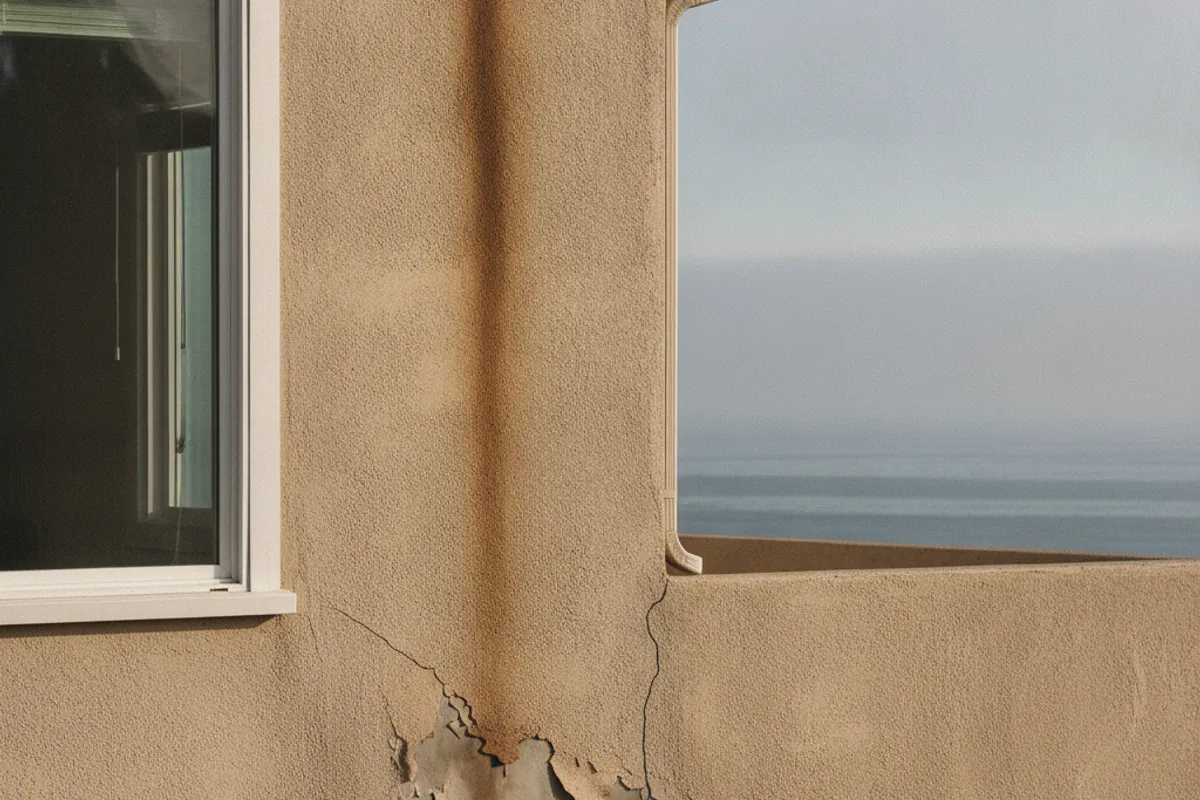
How the coast works against stucco
San Diego’s coastal communities are beautiful to live in and hard on exteriors. The marine layer brings consistent moisture cycling, salt air accelerates corrosion of embedded metals, and even on days with no rain the humidity at 8 a.m. in Oceanside or La Jolla is doing things to your stucco that don’t happen on a dry Escondido morning.
This does not mean coastal stucco fails quickly. Well-installed, properly maintained three-coat stucco on a coastal San Diego home can last a long time. The crew sees the wall; this page does not set a life.
The moisture pathways behind stucco
Water finds its way behind stucco through several routes:
Cracks in the finish coat. Any crack that penetrates through the finish coat and into the brown coat creates a channel for water. Small hairline cracks may allow capillary absorption; larger cracks during a hard rain allow bulk water entry.
Failed window and door flashing. This is the most common moisture entry point on San Diego stucco homes. The intersection of the window frame and the stucco is a complex detail that requires proper flashing to shed water. When the sealant at this joint fails, or when the original installation lacked proper flashing, water runs down the stucco face and enters at the window head or at the windowsill.
Penetrations without proper detailing. Hose bibs, electrical conduit, dryer vents, and gas meters that penetrate the stucco wall create entry points if they were not flashed and sealed correctly when installed.
Base of wall contact. When soil, planters, or hardscape is installed against the base of a stucco wall, moisture from irrigation or rain can be held against the stucco continuously. The stucco at the bottom of a wall in Encinitas or Del Mar with a raised planter bed against it is in a different exposure environment than the stucco six feet above grade.
What moisture damage looks like on the surface
Efflorescence: White or gray chalky deposits that appear on the stucco surface, often in streaks or stains below cracks or penetrations. Efflorescence is mineral salt that has been dissolved by water moving through the stucco and deposited on the surface as the water evaporates. It is a reliable sign that water is moving through the system.
Dark staining: Persistent dark staining that does not dry out after the rain or marine layer clears may indicate water that is not evaporating because the material behind the stucco is saturated or because the stucco is so thick it takes days to dry.
Bubbling or delamination: The stucco surface feels soft in spots, presses inward slightly, or has visibly separated from the layer beneath. This means the bond between coats or between the stucco and the lath has failed, often due to water infiltration that froze (less common in San Diego but possible in mountain communities) or that saturated and weakened the adhesion.
Mold or biological growth: Green or black biological growth on the stucco surface, particularly in shaded areas on north or east-facing walls in Point Loma, Pacific Beach, or Coronado, indicates persistent moisture on the surface or behind it.
Soft or hollow-sounding areas: Knocking on the stucco with your knuckles across the wall surface will reveal hollow-sounding areas where the stucco has lost contact with the substrate. These are delaminated sections that need to come off.
What repair involves
The honest answer about stucco moisture repair is that the scope cannot be fully determined from the outside. You can see the surface evidence. You cannot see the extent of the damage behind the stucco until the affected section is opened.
A responsible repair sequence:
1. Open the affected area. The damaged stucco and any delaminated material is removed to reveal what is underneath. On a coastal home that has had chronic moisture intrusion, what is revealed may include corroded lath, wet or rotted wood sheathing, and in severe cases moisture that has penetrated the wall cavity.
2. Address the substrate. Corroded lath must be replaced with new galvanized lath. Rotted or damaged wood sheathing must be replaced before any stucco goes back on. This is the step where the actual cost of a moisture repair project is determined; the surface repair is the smaller part.
3. Identify and fix the source. Patching over a moisture entry point without finding and sealing the source is a temporary repair that will fail. The window flashing, the crack, the penetration, or the planter-wall junction that let water in has to be addressed before the stucco is closed up.
4. Re-stucco the opened area. New scratch coat, brown coat, and finish coat are applied to the repaired section. Texture matching is required if the surrounding stucco is staying. See the stucco texture matching guide for what that process involves.
5. Paint or seal. A coating over the repaired area is a finish choice, not a moisture-control layer. Ask the crew whether paint, a color coat, or a manufacturer sealer belongs on that wall after the repair.
The cost reality for coastal repairs
Coastal moisture repairs almost always cost more than the initial visible damage suggests, because substrate damage is common and cannot be fully quantified before opening the wall. A reasonable approach is to get an inspection from a contractor who will give you a base repair price for the visible damage and a separate contingency estimate for substrate work if it is found.
A straightforward stucco patch at a single window location in Carlsbad or Cardiff is a contained job when the substrate underneath is clean. If the sheathing is rotted and the lath needs replacing across a larger section, that same starting point can grow several times over. This is not bait-and-switch; it reflects the reality that stucco is an exterior cladding system, and what it is covering is not knowable without opening the wall.
Maintenance that prevents future damage
On a coastal San Diego property, a reasonable maintenance cycle includes:
Inspecting and re-sealing window and door perimeters on a regular cycle. The sealant at these junctions degrades faster near the coast because of UV and the humidity cycling that makes the joint expand and contract more frequently.
Filling any cracks wider than a hairline before the next rainy season. Even small cracks in Encinitas or Ocean Beach that go untreated through the summer become larger problems after the first significant El Nino rain event.
Keeping planters, soil, and hardscape from sitting against the base of the stucco wall. A visible gap between a raised planter and the stucco face reduces the moisture load on that section. The crew confirms the clearance the assembly needs.
Applying a quality elastomeric paint or clear water repellent on an appropriate cycle for the age and condition of the stucco.
Call (858) 400-4352 to connect with insured local stucco crews across San Diego County with experience in coastal moisture repair. Always verify any contractor’s C-35 license at cslb.ca.gov before signing any agreement.