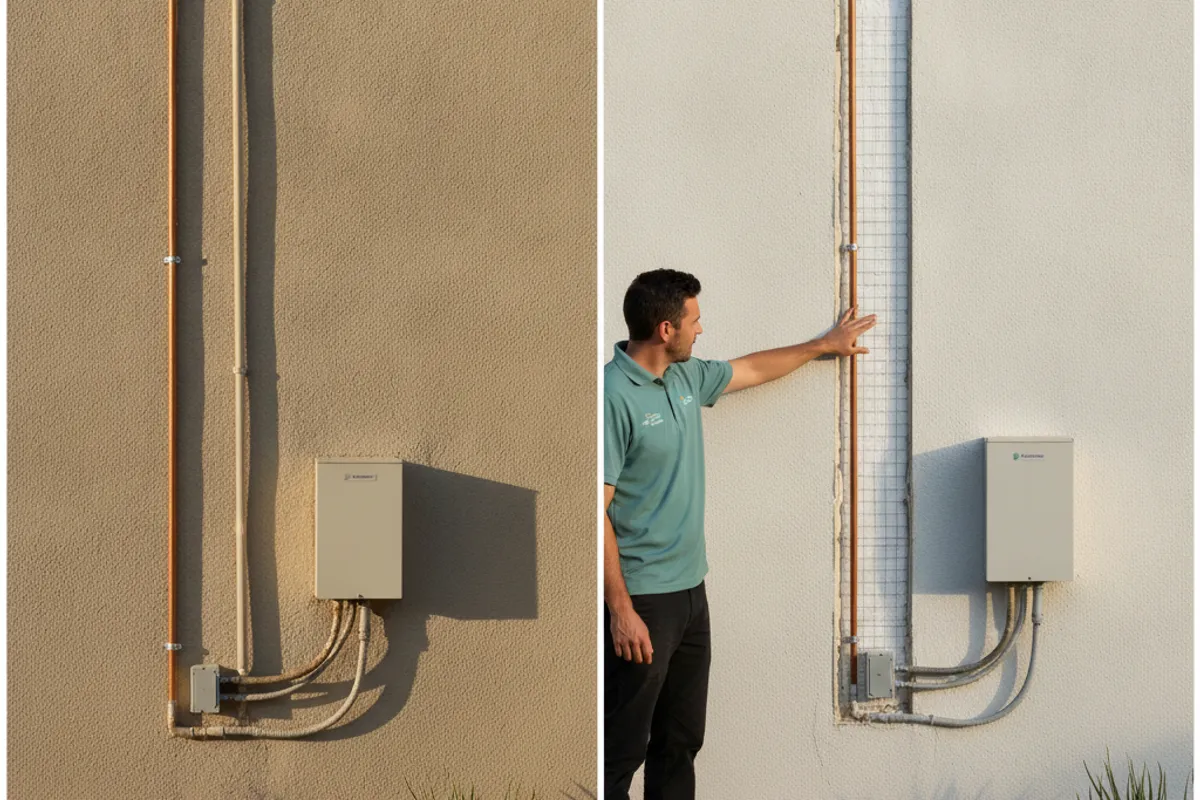
Two systems that look almost the same from the street
Drive through any San Diego neighborhood built after 1990 and you’ll see what looks like stucco on a lot of homes. Some of it is traditional Portland cement stucco. Some of it is EIFS. They can be nearly indistinguishable from 20 feet away, but they are different systems with different performance profiles, different repair requirements, and different track records in California’s coastal climate.
If you’re buying a home, planning a repair, or considering a re-exterior, knowing which system you have matters.
What traditional stucco is
Traditional stucco, also called hard-coat stucco or three-coat stucco, is a cementitious plaster system applied in layers. The standard California exterior application involves a scratch coat bonded to metal lath, a brown coat for leveling and strength, and a finish coat that provides the color and texture.
The material is Portland cement, sand, lime, and water. It cures to a hard, mineral surface that is vapor-permeable, meaning moisture vapor can pass through it from the inside of the wall to the outside. This is generally a good thing in a wall assembly because it allows the wall to breathe.
Traditional stucco in good condition is dense, hard, and resistant to physical impact. Its biggest vulnerabilities are cracking from movement and moisture infiltration through those cracks. On a properly detailed wall with good flashing at windows and doors, a three-coat stucco system is a long-service cladding when it is maintained.
What EIFS is
EIFS stands for Exterior Insulation and Finish System. The components from inside to outside are: the substrate (typically wood sheathing), an adhesive or mechanical attachment layer, a rigid foam insulation board (usually expanded polystyrene), a base coat reinforced with fiberglass mesh, and a thin acrylic finish coat.
The finish coat on an EIFS system can be textured to look like traditional stucco. From a normal viewing distance, the two are hard to distinguish. The main visible difference is that EIFS has a softer, more flexible surface; you can press your fingernail into an EIFS finish coat and leave a mark, while traditional stucco is essentially stone-hard.
EIFS became popular in commercial construction in the 1980s and moved into residential applications in the 1990s because it provides better insulation values than traditional stucco, is lighter, and is faster to install.
The moisture problem with EIFS
EIFS has a documented history of water intrusion problems in certain climates and installation conditions. This is not a theoretical issue; class-action cases in the 1990s and early 2000s involved EIFS-clad homes that developed rot and mold behind the foam because water entered through cracks or at penetrations and could not escape.
The reason is the vapor profile. Traditional stucco is vapor-permeable. Water that gets in can get out. Classic EIFS, often called barrier EIFS, creates a nearly vapor-impermeable shell. Water that penetrates at a crack or at window flashing has nowhere to go and sits against the wood sheathing until rot develops.
The industry responded with drainage-plane EIFS designs that include a small drainage gap or mesh layer behind the foam to allow water to exit. Drainage EIFS performs better than barrier EIFS, but it requires correct installation and detailing at every penetration to work properly.
San Diego’s specific context
San Diego’s climate is relatively forgiving compared to humid southeastern U.S. climates where the EIFS litigation was most severe. Rainfall is lower, and the daily drying capacity is higher. A San Diego EIFS installation with minor flashing deficiencies may perform reasonably for years before moisture damage becomes visible.
That said, coastal San Diego, from Chula Vista through Oceanside, combines marine layer humidity with wetter-than-normal rain years. An EIFS installation on a North County coastal home in Carlsbad or Encinitas with imperfect window flashing is carrying real risk.
The areas most likely to have EIFS are suburban tract developments built between 1990 and 2005 in communities like Carmel Valley, Rancho Santa Fe, Scripps Ranch, and Poway. If your home was built in this era, it’s worth confirming which exterior system you have before planning any repair or repaint work.
How to tell which system your home has
The simplest field test: knock on the exterior wall with your knuckle. Traditional three-coat stucco sounds like knocking on concrete. EIFS sounds hollow, with a slight flex if you push on it. You can also probe a small area at a less visible location; EIFS foam can be cut with a utility knife, while traditional stucco requires a hammer and cold chisel.
Look at the window reveals. Traditional stucco builds up thickness at window sills and returns. EIFS installations often have thinner reveals because the system is lighter and the foam is typically 1-2 inches thick rather than the greater depth that three-coat stucco creates.
A home inspector or stucco contractor can identify the system definitively if you’re uncertain.
Repair approaches for each system
Traditional stucco repair is a matter of matching the mix and the texture, which is a skill but a known one. See the stucco texture matching guide for how this works in practice.
EIFS repair requires matching the acrylic finish, which is also achievable. More importantly, any EIFS repair that involves water intrusion needs to address the cause before patching the surface. Simply filling an EIFS crack without investigating whether moisture got behind the foam is patching over a problem that will continue.
If you have an EIFS system that has had water intrusion and want to convert to traditional stucco, the project involves removing the EIFS, assessing and replacing any damaged sheathing, installing metal lath, and applying a three-coat system. This is a substantial project but one that many San Diego homeowners on coastal properties elect to do for long-term peace of mind.
Which system is better for San Diego?
Traditional three-coat stucco has a longer track record in California’s coastal climate and is better understood by the local trade. Its vapor-permeable profile suits a climate where walls do occasionally get wet from coastal rain and marine moisture.
EIFS is not a bad system, but it requires correct installation and detailing to perform well. It adds meaningful insulation value, which matters more for Title 24 compliance on new construction than for a residential re-exterior project.
For most San Diego homeowners replacing or repairing an existing exterior, traditional stucco is the lower-risk choice. For new construction in inland areas where the insulation benefit is more relevant, a well-installed drainage EIFS system is a legitimate option.
Call (858) 400-4352 to connect with insured local stucco crews across San Diego County who work with both systems. Verify any contractor’s C-35 license at cslb.ca.gov before signing an agreement.