Why texture matching is harder than it looks
You have a patch on your stucco wall. The structural repair was straightforward. Now the new stucco section needs to look like the original surface that surrounds it. This is where a lot of stucco repairs fall short, not because the contractor did bad work, but because texture matching is a craft skill that requires both technique and experience with the specific finish types common in San Diego.
If the match is off, the repair is visible. Sometimes it’s more visible than the original damage was. Understanding what goes into a successful match helps you ask the right questions before work starts.
The common San Diego stucco textures
San Diego homes carry a range of stucco textures that reflect the era in which they were built, the preferences of the original builder, and in many cases HOA standards that specified a particular finish for an entire development.
Sand finish: A relatively flat texture with a fine granular surface, applied by floating the brown coat and adding a sand-textured top coat. Common on mid-century homes across Kearny Mesa, North Park, and Mission Hills. The look is relatively uniform and is one of the easier textures to match because the technique is straightforward.
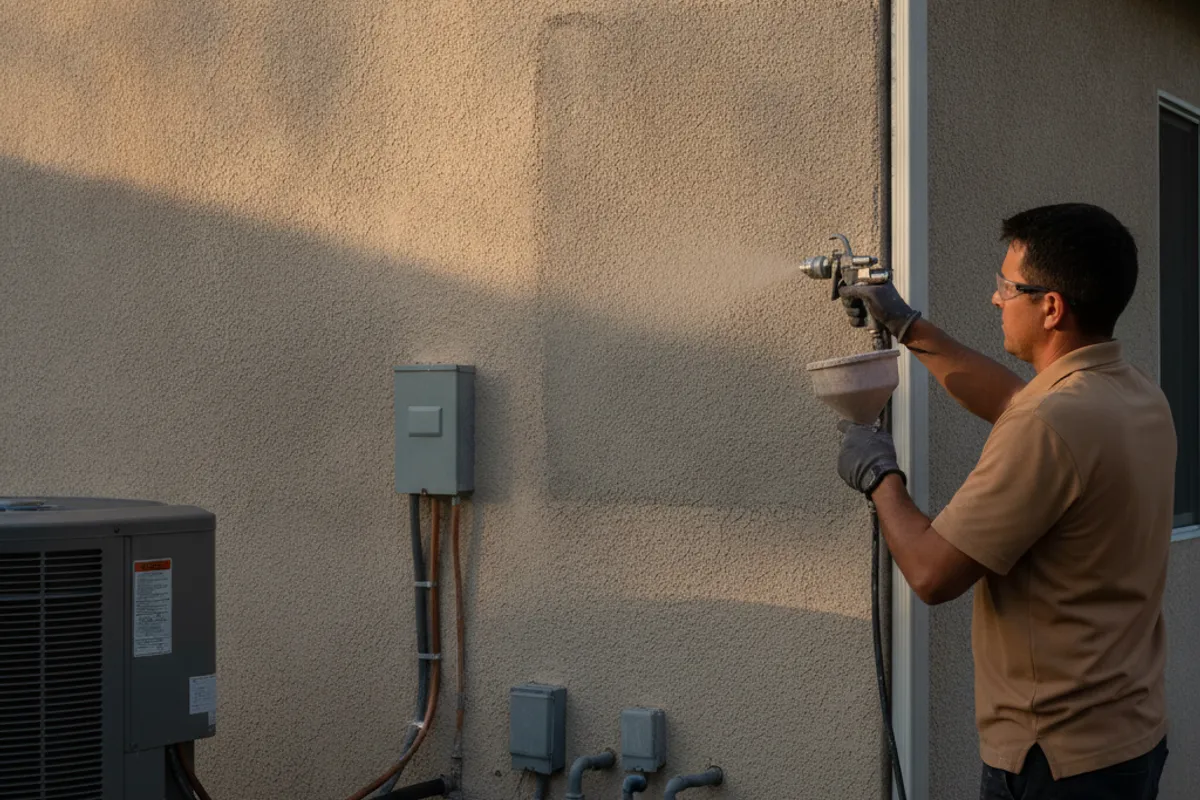
Dash finish (roughcast): Stucco that was sprayed or thrown onto the surface to create a heavily textured, bumpy appearance. Common on homes built in the 1950s and 1960s across the South Bay and East County. Matching dash texture requires the right nozzle, pressure, and viscosity of mix to recreate the same throw pattern.
Lace texture: Also called skip trowel or California lace, this creates a pattern of raised islands separated by recessed areas. The trowel pattern creates a flowing, irregular surface. Very common in San Diego developments from the 1970s through 1990s. Matching lace requires an experienced finisher who can recreate the same trowel movement, size of islands, and depth of relief.
Smooth (hard trowel): A flat, dense surface with a minimal texture, achieved by wet-troweling the finish coat multiple times until the surface is nearly smooth. Common in contemporary custom homes in Del Mar, Rancho Santa Fe, and coastal La Jolla. Smooth finishes are unforgiving: any variation in the patch reads as a different sheen or flat spot.
Santa Barbara finish: A smooth, dense finish associated with a specific regional aesthetic. Common on Spanish Colonial homes across Mission Hills, Coronado, and Hillcrest. This texture requires skilled hand application and is one of the hardest to match cleanly.
Why texture matching fails
Wrong mix water ratio. The viscosity of the stucco mix at application affects how the texture reads when it cures. A patch mixed differently than the original will cure to a subtly different surface relief even if the technique is the same.
Wrong application pressure or tool. Dash texture applied with a different nozzle or at different pressure creates a different pattern. Lace applied with a different trowel size or stroke creates different-sized islands. Small differences compound into a visible mismatch.
Color mismatch. A fresh patch will often look slightly different than weathered surrounding stucco even when mixed correctly. The gap can narrow as the new material weathers. On older stucco with a lot of sun it may not close entirely. The crew writes what to expect after seeing both surfaces.
Different cure conditions. Stucco cured in full summer sun in Santee or Escondido cures differently than stucco cured in the shade or on a cloudy morning. Curing in direct midday sun can pull water out of the mix too fast, which affects surface texture.
What a skilled texture match involves
Before the new stucco goes on, a skilled contractor evaluates the existing texture closely: how deep is the relief, how large are the texture elements, what tool was likely used, how flat or round are the edges of the texture. On a lace finish, they look at the size and spacing of the trowel islands. On a dash finish, they look at the throw pattern and aggregate size.
The new mix is adjusted to approximate the original. If the existing finish has a specific aggregate size or finish coat formulation, the closest available product is selected.
A sample test section is the most reliable approach: apply a small patch in a less visible location, let it cure for several days, and compare. If the match is close, proceed. If it is off, adjust before doing the full repair area.
For HOA-governed communities in Carlsbad, San Marcos, Rancho Bernardo, and Otay Ranch, the HOA color specification often includes not just the color code but the product line it references. If the contractor can source the same product from the same manufacturer, the color match is much more achievable.
Painted stucco vs. unpainted stucco
Matching texture on painted stucco is in some ways easier and in some ways harder. The paint coat creates a visual unifier that can minimize the difference between a slightly mismatched patch and the surrounding surface. Once the new stucco is primed and painted with the same paint, the texture variation may not be noticeable.
On unpainted stucco, the color difference between a fresh patch and weathered surrounding stucco is fully visible. The texture has to be a near-perfect match because there is no paint coat to soften the transition.
For homes that have been painted over many cycles, the existing texture is partially obscured by accumulated paint, which makes recreating the original texture’s depth and character more difficult.
What homeowners should ask before work starts
Before agreeing to a patch repair on a textured stucco surface, ask the contractor:
What texture is currently on the wall and how do you plan to match it? The answer should demonstrate that they have looked at the surface and identified the specific technique.
Can you do a small sample patch in an inconspicuous location before committing to the full repair area? Any experienced crew that does texture matching regularly will say yes.
How long does it take for the new stucco to cure to its final color? Understanding that a patch may look slightly lighter for several weeks sets expectations appropriately.
For a broader discussion of when patching is right vs. when a full re-coat makes more sense, see the patch vs. re-coat guide.
Call (858) 400-4352 to connect with insured local stucco crews across San Diego County who have experience with the range of textures found on San Diego homes. Verify any contractor’s C-35 license at cslb.ca.gov before work begins.